
This wasn’t a Nike mistake. It was a choice.
Nike’s recent running campaign has triggered the usual wave of reaction, criticism of tone, debate over wording, and plenty of people deciding whether it crossed a line.
Some have taken offence. Others have questioned the thinking behind it. A few have put it down to poor execution.
That doesn’t feel like the right conclusion.
What we’re seeing is something much more deliberate, a positioning decision that’s been interpreted as a mistake.
One of the most common issues we see with clients is the desire to appeal to everyone. It sounds sensible, even commercially logical, but in practice it leads to safe, diluted messaging that fails to connect with anyone in a meaningful way. The brands that stand out tend to do the opposite. They decide who they are for, speak clearly to that audience, and accept that not everyone will like what they have to say.
Nike has built its reputation on exactly that approach. Its messaging has never been about comfort or universal appeal; it leans into effort, discipline, and pushing yourself further. That resonates strongly with a certain type of person, particularly those who take their sport seriously or aspire to improve. For others, especially those who approach running in a more relaxed or social way, the same message can feel uncomfortable or even slightly critical.
That difference in reaction says more about the audience than it does about the line itself.
It also reflects a broader shift in running culture. Take parkrun as an example. What began as a timed run, built around performance and personal improvement, has evolved into something far more inclusive and community-led. Participation is now just as important as performance, and for many people, the appeal lies in simply being part of it.
The result is that two distinct mindsets now exist in the same space. One group still sees running as a way to measure progress and push for better times, while another values accessibility, wellbeing, and the social side of the event. Neither is wrong, but they are fundamentally different. When a brand chooses to speak more directly to one of those groups, it won’t land evenly with the other.
That’s exactly what’s happened here.
There’s also a wider point around how we respond to brand messaging. We now live in a world where every opinion can be shared instantly and publicly, which creates the impression that every message needs to be universally acceptable. In reality, that’s neither possible nor desirable. Not everything is meant for everyone, and not every piece of communication needs to be reshaped until it offends no one.
A more useful question is whether the message works for the audience it was intended to reach.
In this case, Nike appears to have made a clear choice. The campaign speaks more directly to committed runners and those who value effort and progression, even if that means it feels out of step with a more inclusive, participation-led mindset. That’s unlikely to be an oversight. It’s a conscious trade-off.
You can agree with that approach or disagree with it, but it doesn’t make it wrong.
If anything, it reinforces a point that applies just as much to businesses as it does to global brands. The moment you try to cater for everyone, you start to lose clarity. The brands that stand out are the ones that are prepared to draw a line, even if that means some people sit on the other side of it.
You don’t have to like every message you see, and you don’t have to agree with the stance behind it. But it is worth recognising when something wasn’t designed with you in mind in the first place.
That’s not a failure of the brand.
It’s the point.
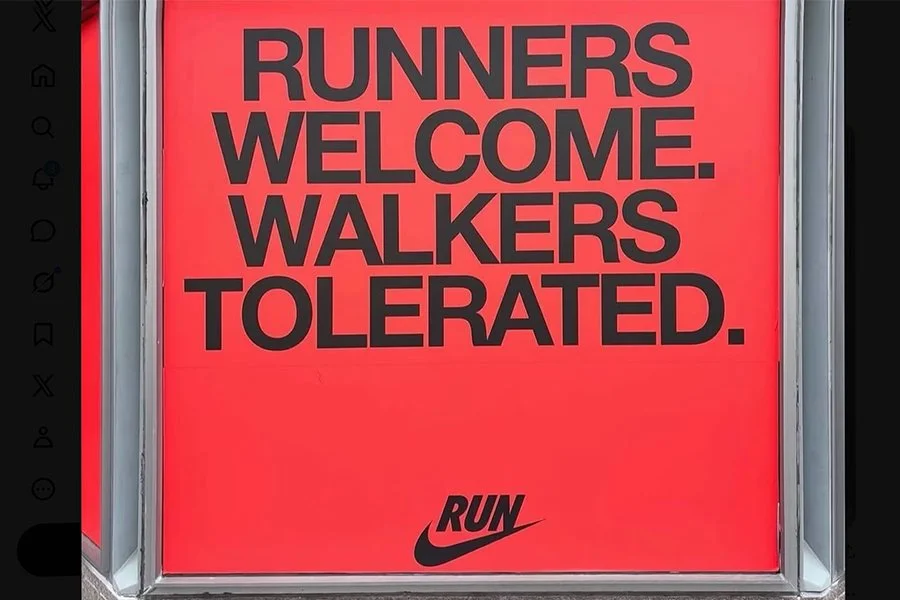
Nike campaign poster, Boston, 2026
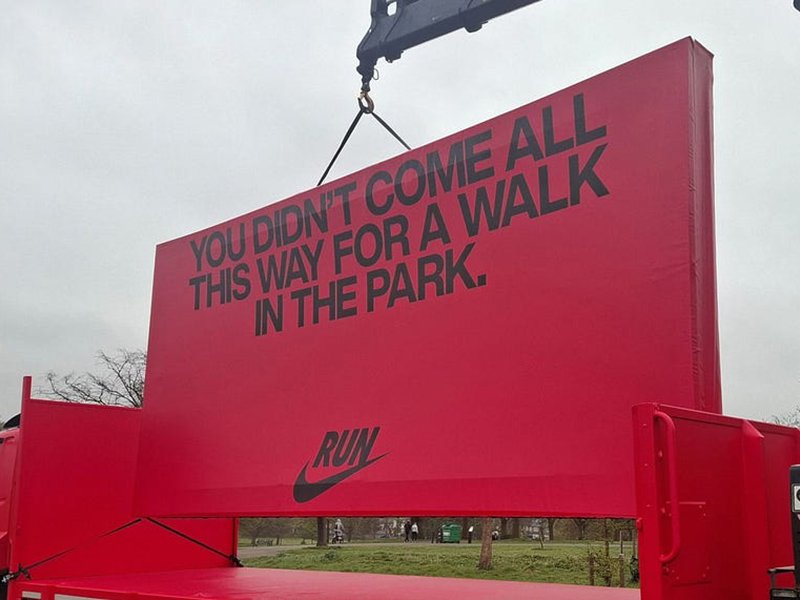
Nike campaign poster, London, 2026
